Turkey is one of the most rewarding places you can visit, and the overwhelming majority of taxi drivers are honest people doing a hard job in heavy traffic. But in every big tourist destination a small minority sees visitors as easy money, and taxis are the single most common complaint reported by people visiting Istanbul. This guide focuses on Istanbul, but almost everything here applies in Antalya, Izmir, Bodrum, Cappadocia and any other city you travel to.
The goal is simple: by the time you finish reading, you should be able to step into any taxi in Turkey, know roughly what the ride should cost, recognise every common trick before it happens, and know exactly who to call if something goes wrong.
Before you get in: two habits that protect you
There are two things you should do every single time, before the wheels even start moving.
1. Record the licence plate
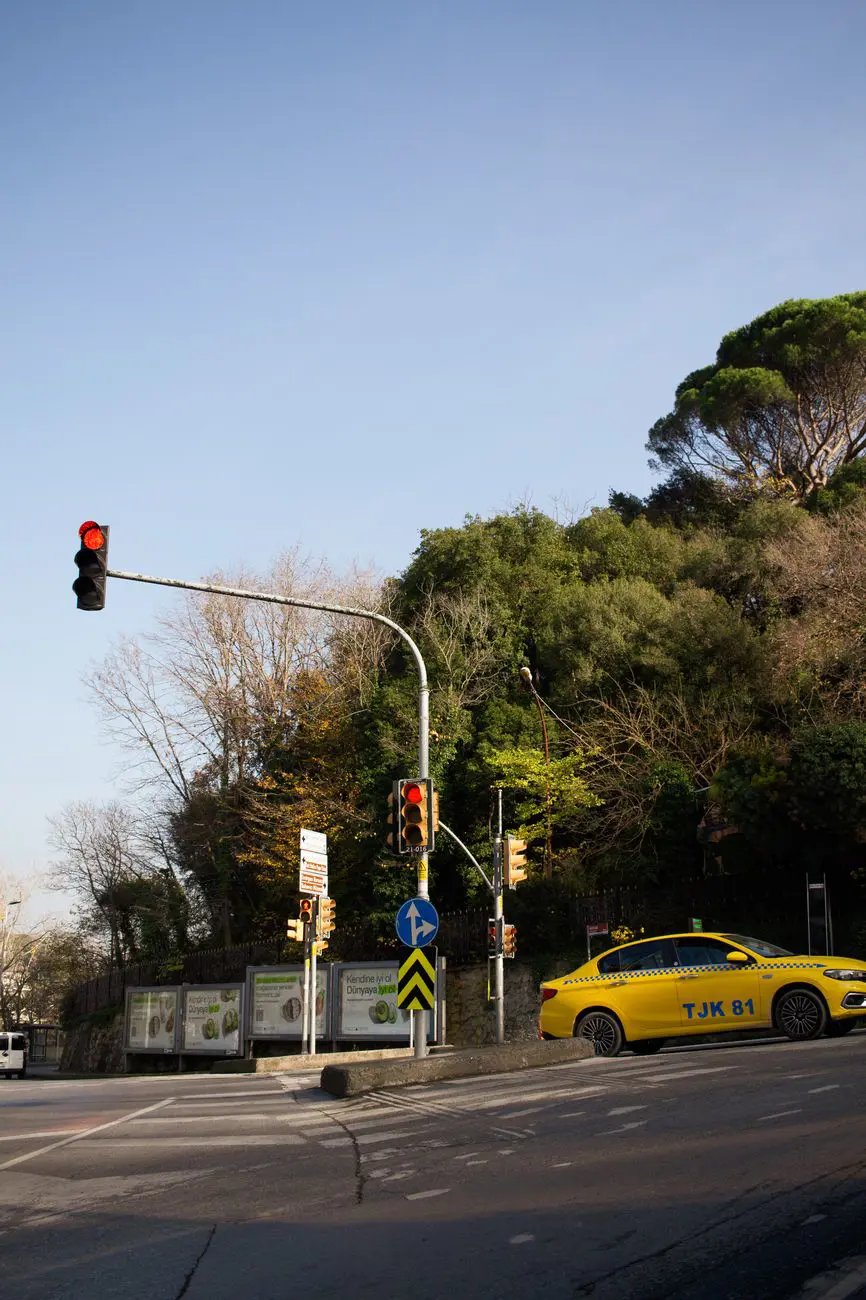
Every taxi in Turkey has its licence plate displayed clearly on the outside of the car, and Istanbul plates always begin with 34 (Ankara is 06, Antalya 07, Izmir 35, and so on). Note it or photograph it before you set off. Without the plate number, no complaint can go anywhere — with it, the authorities can identify the exact vehicle. This one habit is the foundation of everything else in this guide.
2. If you are worried, record video discreetly
If you have any feeling that a ride might go wrong, quietly start recording video on your phone without making it obvious to the driver. A calm video of the meter, the route and any argument over payment is the strongest possible evidence if you later report the driver. You do not need to announce it or wave your phone around — just keep it running.
The golden rule: the meter is the law
This is the most important fact in the entire guide. In Turkey, running the taximeter is legally mandatory. Any taxi journey carried out without the meter switched on is illegal. A driver who refuses to start the meter is not offering you a deal — he is breaking the law.
So the rule is absolute: when you get in, point at the meter and say "taksimetre". If the driver claims it is broken, says "fixed price is better for you," or makes any excuse not to run it, do not negotiate — get out and take another taxi. There is no situation in which an off-meter ride works in your favour.
One more reassurance: Istanbul abolished the separate night tariff years ago. There is no longer any day/night price difference — the fare is the same 24 hours a day. If a driver tells you it is "night price, double," that is simply false. You can say "gece tarifesi yok" ("there is no night tariff").
Know the real price before you ride
The best defence against an inflated fare is knowing roughly what the trip should cost. Istanbul taxi rates are fixed citywide — there is no village/city difference and no day/night difference.
🚕 Check the current fare with our live calculator. Taxi tariffs in Istanbul change roughly once or twice a year, so instead of memorising numbers, use our always-up-to-date Istanbul Taxi Fare Calculator. Enter your trip distance and it shows what a metered ride should cost at the current official tariff — a quick sanity check before you agree to anything.
As a rough rule of thumb, a standard yellow taxi charges an opening fare plus a per-kilometre rate, with a minimum fare for very short trips. Because a minimum fare applies almost immediately, a very short hop can feel expensive — that is normal and not a scam. Legitimate bridge and tunnel tolls (for example crossing the Bosphorus) are added to the meter and are genuinely your cost to pay — just watch that the exact toll is added, no more. For the exact current figures, use the fare calculator above.
Whatever estimate you get, treat it as a sanity check: if the driver wants two or three times that amount, something is wrong. You can also check the distance and expected route in Google Maps or Yandex Maps before you leave.
The scams, and how to beat each one
The "broken meter" / fixed-price trick
The driver says the meter is broken, or that a fixed price is "better for you," then quotes a flat fare three to five times the real cost. Beat it: the meter is mandatory; if it is off, get out. Never accept a fixed price negotiated on the street.
The long route
The driver takes an unnecessarily long way around to pad the metered fare — most common on airport runs and between tourist districts, where you have no sense of the geography yet. Beat it: before you set off, open Google Maps or Yandex Maps, set your destination, and follow the route as you ride. Keep your phone visible so the driver knows you are watching. Note that the shortest route is not always the best one — a driver may legitimately choose a faster road that looks longer on the map. Use common sense: a small difference is normal, but if a 10 km trip turns into 30–40 km, you are being taken for a ride in every sense.
The banknote switch
This is the nastiest one. You hand over a 200 TL note; with fast hands the driver palms it and shows you a 20 TL note, insisting you underpaid. The old 200 and 20, and the 50 and 5, can look similar in a hurry. Beat it: say the amount out loud clearly as you hand the money over ("two hundred"), and pay with smaller notes so there is nothing to switch.
"I have no change"
The meter reads 340 TL, you hand over 400 TL, and the driver pats his pockets and claims he has no change, hoping a tired tourist will say "keep it." Beat it: always carry small bills — 10, 20, 50 and 100 TL notes. Never try to pay a small fare with a very large note.
The currency-conversion con
This one specifically targets foreign visitors. Say the fare is the equivalent of 50 euros, which at the real rate might be around 2,600 TL. The driver pulls out his phone and "shows" you a conversion claiming it is 7,600 TL, and pressures you to pay that. Beat it: never trust the driver's phone for the exchange rate. Do the conversion yourself — the simplest way is to type the amount straight into Google (for example "50 euro to try") and read the live rate. Your phone, your conversion, every time.
The card-payment surcharge
When you pay by card, the amount charged may come out very slightly higher than the cash figure, which can be a normal processing difference. Beat it: a difference of 1–2% is acceptable; anything beyond that is not. If the driver claims a large "credit card fee," treat it as a red flag.
The "bridge is closed" lie
The driver claims a road or bridge is closed so he can take a longer, more expensive route. In reality bridges are very rarely closed to traffic, and any real closure around tourist areas is announced well in advance. Beat it: check the route yourself on your map app; the Istanbul Metropolitan Municipality also publishes live road and traffic information.
The commission detour
The driver insists your hotel is "full" or "bad" and offers to take you to a "better" hotel, shop or carpet store — where he collects a commission. Beat it: be firm about your actual destination and do not let a driver redirect you.
Apps help — but stay alert
Booking through an app is one of the strongest defences, because it logs your driver, your route and an estimated price, and it removes cash sleight-of-hand. In Istanbul the main options are BiTaksi and iTaksi (the city's official municipal app); Uber also operates in Turkey but dispatches licensed yellow and turquoise taxis rather than private cars.
That said, apps are not magic. A growing trick is the driver who accepts your app booking, then — once you are in the car — claims the app "isn't working," cancels the ride on his end, and demands a higher cash price off-meter. Others have reported drivers extending the route well past the app's estimate, or claiming a card payment failed and pocketing cash on top. Beat it: insist the ride runs inside the app as booked, just as you would insist on the meter in a street taxi. If the driver cancels and wants cash, treat it exactly like a broken-meter situation — you can get out. And keep an eye on the in-app route against your own map.
At the airport
Airports are the highest-risk place of all, because you have just arrived, you are tired, and you have no sense of distance. Never accept a ride from anyone who approaches you inside the terminal asking "taxi?" — these touts are almost always a scam. Use the official taxi rank outside, a pre-booked private transfer with a fixed price, the HAVAIST airport shuttle buses, or the metro and Marmaray, which are the cheapest options of all. As a rough sanity check, a metered ride from the airport to the central districts should run into the low thousands of lira depending on traffic and which airport you land at — not five figures. You can estimate it in advance with the fare calculator.
If you get scammed: how and where to report
Most drivers are honest, and reporting the dishonest minority is how they eventually lose their licences. Realistically you may not get your money back on the spot, but a report with a plate number and video genuinely can lead to penalties up to and including the driver losing his licence. Here is exactly who to contact.
While it is happening
Stay calm, state the correct fare firmly, and if the driver is aggressive or refuses to behave, do not hesitate to ask a police officer for help — the police actively want to crack down on these drivers, and a uniformed officer usually ends the argument instantly. If you paid by card and were defrauded, contact your card-issuing bank as soon as possible, because a bank can act far faster than the administrative process to stop or reverse a payment.
Alo 153 — the Istanbul municipality hotline (Beyaz Masa / White Desk)
This is the main channel for taxi complaints in Istanbul. Dial 153 from a Turkish number, or use the international line +90 212 153 00 00. You can also file online through the Istanbul Metropolitan Municipality's solution centre at cozummerkezi.ibb.istanbul (it has an English page) or the portal at alo153.ibb.gov.tr, and you can email [email protected] with your photos and details. In every case, the licence plate is essential, and the date, time and pickup/drop-off locations strengthen your report.
The Tourist Police (Turizm Polisi)
For tourists there is a dedicated Tourist Police, with stations in the main visitor areas including Sultanahmet, who specialise in helping foreign visitors and can take an official report. Filing a report there is also useful for any travel-insurance claim. For a general police emergency anywhere in Turkey, dial 155.
Through the app
If you booked through BiTaksi, iTaksi or Uber, report the driver inside the app as well — it ties the complaint directly to that driver's record.
The short version
If you remember nothing else: photograph the plate, insist on the meter (it is the law), follow your own route on your own map, do your own currency conversion on your own phone, carry small bills, and use an app where you can. Do those things and you have removed almost every tool a dishonest driver has. Turkey is a wonderful, safe and welcoming country — a little awareness is all it takes to keep a tiny minority of bad actors from touching your trip.